It was at Café Schmitz, in Cologne, on a Monday night, that I met Ubeimar Ríos. The cold, the quiet streets, and that suspended feeling of the start of the week sketched out a contained, almost discreet setting; neutral enough for everything else to take center stage. The city, in that moment, was merely a backdrop: an excuse to get closer to Oscar Restrepo. Or rather, to the man who embodies him.
The meeting point was Filmpalette, for the premiere of Un Poeta, the latest film by Colombian director Simón Mesa Soto. Ubeimar didn’t take long to appear. The audience watched him with evident admiration and, at the same time, approached him with an unusual sense of closeness. There was something about him, a mix of warmth and presence, that made people trust him instantly.
Between compliments, comments, and selfies—many selfies—the audience began to connect with Ubeimar. I ended up acting as a translator on several occasions; language, at times, felt like a minor detail. What was happening around Ubeimar had more to do with a shared reaction than with precise words.
With a completely full theater, expectations were high. And for good reason. By this point in its run, Un Poeta had already passed through widely recognized international festivals, accumulating awards and mentions, including its recognition in the Un Certain Regard category at the Cannes Film Festival.
But it wasn’t until after the opening remarks, during those two special screenings, that the night really began for us. We stepped out of the theater, ordered two beers, and found a table by the window. Notebook, recorder, and a conversation that lasted over thirty minutes, which, without knowing it yet, would end up shaping this text.
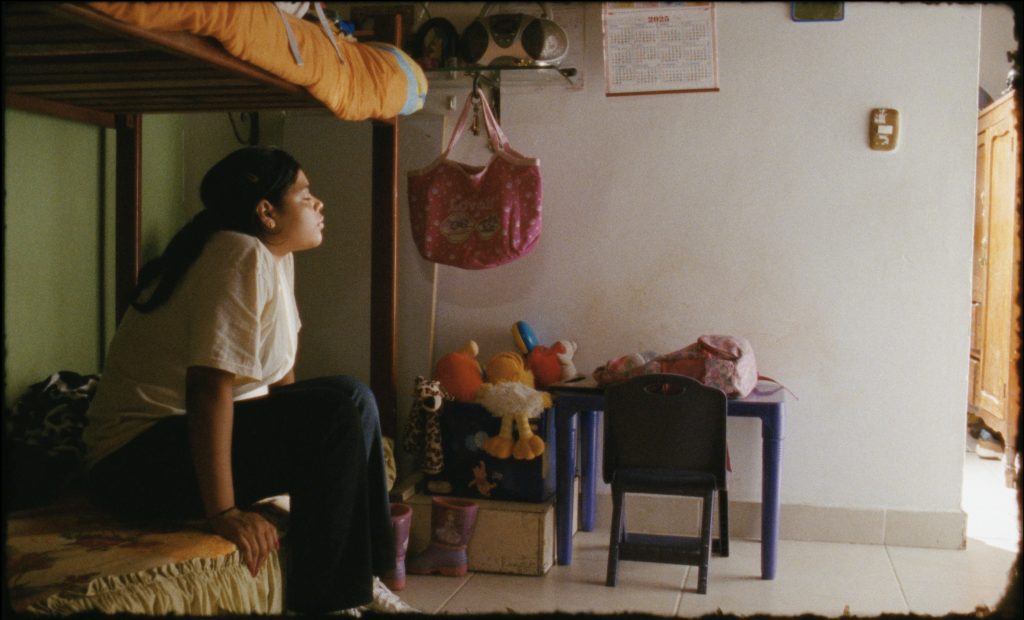
M: You’ve probably heard this many times already, but I can’t miss the chance to personally congratulate you on the film and the journey it’s been having. I’m especially interested in how you came to the role of Oscar. From the outside, it feels less like something you pursued and more like an encounter, as if the film found you. Do you feel that the role, in some way, was meant to find you?
U: Thank you for your words, Mateo, and a very special greeting to the readers of Miscelanea. Yes, it was exactly like that. The “culprit” behind me being in the film is my wife Clara’s nephew, who is a close friend of Simón. He read the script and kept saying that character was me.
A year passed before they called me for a second casting, which also coincided with my recovery from surgery, so the whole process was quite particular. But yes, it does feel like the film found me… although in some way I also ended up finding it.
M: While watching the film, I constantly felt that Un Poeta wasn’t only about poetry. It could just as easily have been called A Filmmaker, A Musician, or An Actor, because what runs through the story are very universal tensions within artistic practice: frustration, self-sabotage, the search for authenticity. From that perspective, what was it like to embody a character who doesn’t just represent a poet, but a much broader condition of being an artist?
U: Simón wanted, in a way, to exorcise himself, because the poet is, at the core, him. The film comes from a very personal question: what would happen if, after a first success—like the one he had with Amparo—he never made another film.
So yes, it could have been any kind of artist. And giving form to that question wasn’t easy.
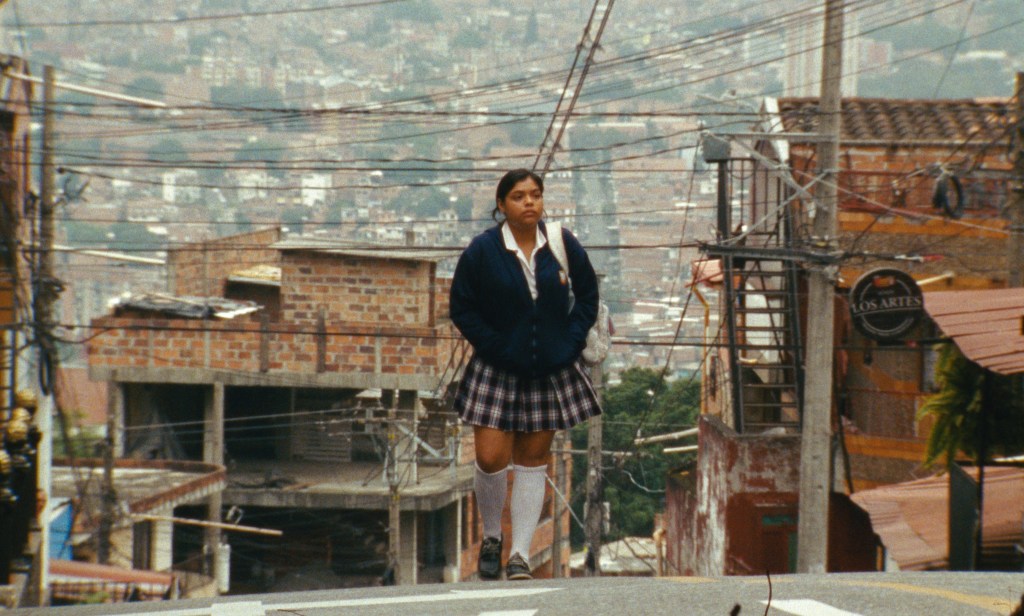
M: There’s something in the way Oscar relates to poetry that I find conflicting. His decision to sustain it as his sole purpose in life can, at times, be read as deeply romantic, but also as naive—even selfish—if considered within a context like Colombia.
From that perspective, how do you understand the character’s insistence? Is it a radical stance toward art, or more a form of escape?
U: There’s a problem in the system, that’s clear. There are professions where it’s easier to achieve economic stability than in the arts. It’s not absolute, but it is a reality.
In Óscar’s case, the issue is that he only wanted to be a poet, nothing else. And there comes a point where he doesn’t even really try anymore. He lives from the nostalgia of what he once was, and that takes him to very dark places.
M: Thinking about your trajectory as a teacher, more than thirty years teaching philosophy and ethics, there’s something that really interests me: the film observes educational environments and dynamics in neighborhoods and schools with a lot of sensitivity.
If we bring that into the present, into a context shaped by social media, constant overstimulation, and tools like artificial intelligence, what would you say are the main challenges for a teacher today?
U: These are times where we have tools that can make learning easier, but they can also make it harder. Some teachers adapt easily, others not so much.
I consider myself, at times, a “technological illiterate.” I even struggle to install apps. But beyond that, what still matters is teaching with passion and patience.
M: There’s a scene I find especially powerful, where the idea of “big dreams” and “small dreams” comes up. Yurlady recognizes that the dream of being a poet doesn’t belong to her, and chooses to aspire to a simpler, more concrete life.
That opens up a question that feels inevitable: how do we define success today? What does it really mean to be successful? And in Oscar’s case, do you think what he was seeking was success, recognition, or simply validation?
U: I think Oscar was looking for recognition, but self-sabotage was always working against him. For me, success is what Churchill said: going from failure to failure without losing enthusiasm. I make music with my band, Poyesis. Sometimes we had very few plays, but we still felt successful. Now, with the film, other opportunities have come. But the idea of success remains the same.
“We are all natural actors, we just don’t know it. If we pay attention, we could say that we are all acting right now.”
M: There’s also a physical dimension in the film that interests me; from the exposure of the body to the exhaustion in certain scenes. Thinking about that, was there any moment during the shoot that you remember as particularly demanding or revealing in that sense?
U: Yes, several. The film was shot on 16mm, which required a lot of precision. But the hardest was a running scene: more than 400 meters, several takes… I just couldn’t go on anymore. At one point, the whole crew started cheering me on: “Vamos poeta, tu puedes poeta!” I finished the scene, but I had to vomit and cry afterward. It was very intense.
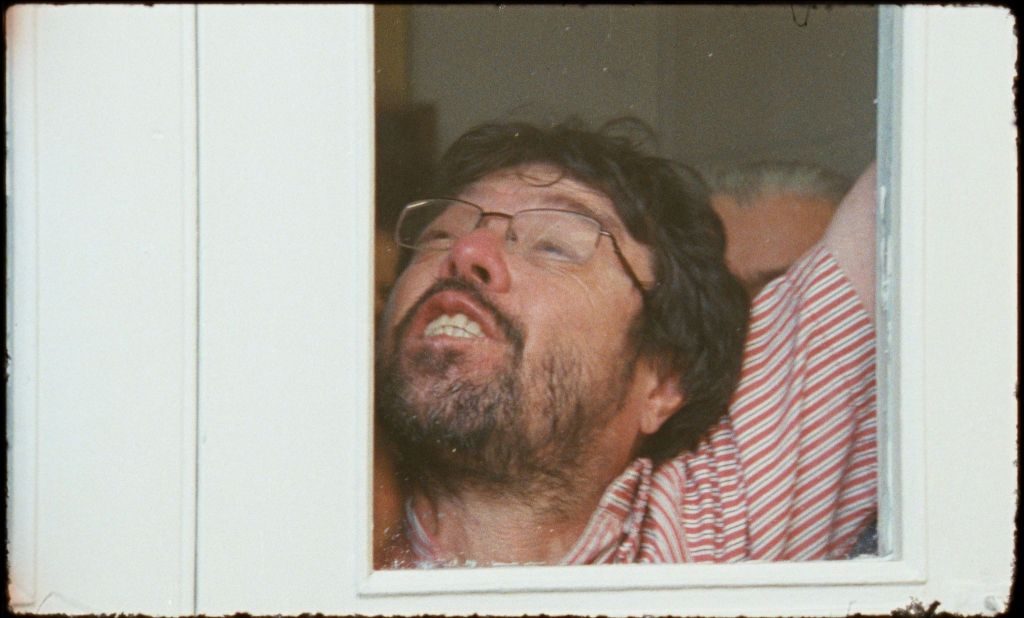
M: The film is deeply local in many ways, but at the same time it feels completely universal. I’m interested in how you’ve perceived audience reactions outside Colombia. What kinds of readings have surprised you?
U: It’s been incredible. In Cannes, people were leaving in tears. In Peru, they said the story felt very close to home. Even in Egypt. I think they identify with the character. Because, in the end, stories like Oscar’s exist everywhere.
Un Poeta doesn’t just speak about failure: it dismantles it. It turns it into an essential part of the creative process, almost a raw material. It reminds us that persistence matters, but so does accepting the fall—inhabiting it, even. That success—if it exists at all—is nothing more than that constant movement between trying, failing, and starting over.
In that back and forth, the film settles into an uncomfortable yet honest place: that of those who keep creating even when there are no guarantees, when recognition arrives late—or doesn’t arrive at all—when vocation outweighs any tangible result. Óscar Restrepo is not an exception; he is a reflection. A mirror that offers more questions than answers.
Perhaps that’s why Un Poeta resonates beyond its immediate context. Because it’s not only about a man who wanted to be a poet, but about all those who, at some point, have held onto a desire that doesn’t always know how to hold them back.
And it is there that the film finds its greatest strength: in reminding us that creating, despite everything, remains a way of insisting on the world.
Special thanks to Jip-Film, Yasmin, Jennifer, Filmpalette for making this interview possible, and of course, Ubeimar Ríos, for a generous conversation in the middle of a demanding schedule.
